
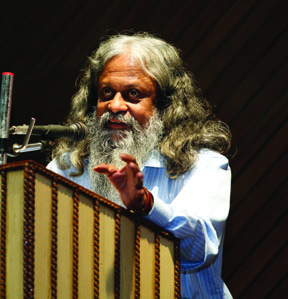
Yagnaswami Sundara Rajan is an eminent Indian, who is a well-known authority in the field of technology development and business management. Y S Rajan has authored and co-authored many books, including more than 200 articles and papers, which have also been published in international journals. NGI’s Mrityunjay Kumar caught up with Rajan.
Excerpts from the interview:
You have penned an interesting and thought-provoking book Vision 2020 along with former President A P J Abdul Kalam in 1994. A lot of things must have changed since then. How optimistic are you about the future of India, given the way the country is moving now?I would like to make a few corrections. The book came out in 1998. The 25 volume Technology Vision 2020 reports were brought out by Technology Information, or Forecasting and Assessment Council (TIFAC) during 1996 and dedicated to the nation by the then Prime Minister on August 2nd,1996. The reports are not the idea of a few — they were steered by about 500 people and had inputs from about 5,000 over two years. The book, coauthored by Dr A P J Abdul Kalam and me, helped to bring the major findings in a condensed and popular form. It also introduced economic dimensions. Fifteen years have elapsed since the reports came out, while it’s been 13 years since the book was published.
Overall, India’s economic size is much more than what was envisaged in the report. That is because the reports and the book were done at a period where there was a dot-com bust and a minor global financial crisis. Also, optimism for growth was very low. But the projections of economies of major countries have changed drastically. China is now the number 2. Indian leadership in global terms in not as much good as was envisaged because other countries have done better. In terms of specific sector, growth in telecom and services have been much more than projected.
More than prediction on sizes, the reports and the book had one very important factor, that is the growth of internal technological strengths of firms and industries (and therefore for the country). On that front, India has lagged behind. Technologies have been imported in embodied, disembodied and other forms. Very little of internal strength save in pharmaceutical and auto sectors and some parts of chemicals. IT, electronics etc are just importers of technologies.
The government and industry have focused on macro statistics of growth and not in sustained and assiduous development of internal technological strength. Such neglect is showing in terms growing current account deficit, where imports are very much higher than exports. Also our exports are critically dependant on imports of many crucial technologies. This is not good for long-term sustainability of national interest.
Also excessive dependence on embodied and disembodied technology imports leads to loss of many jobs within India. On the whole, the details of the processes suggested by many experts, as reflected in the book, have not been followed properly during the 15 years, leading to this situation. It is hoped that at least the basic approach recommended will be followed. I have elaborated on the details of such approach in my book “Empowering Indians with economic, business and technological strengths for the 21st Century (2002)” and many of my other writings. Please visit my website: www.ysrajan.com. Now, it is freely downloadable from my portal.
You have written about improving the agriculture scenario in the country. But what is alarming is that the condition of the farmers is worsening. Hundreds of farmers have committed suicides in Maharashtra and agriculture is often attributed to as gambling with monsoon. What is your opinion?
The TIFAC reports and the book have given a very special attention to agriculture. TIFAC followed up the suggestions in a “walk-the-talk” mode in many parts of India like Bihar, Uttarakhand, Kancheepuram etc; under the leadership of late Prof S K Sinha. In the limited experiments, they helped the farmers and also to become self-replicating.
But agriculture in India is vast and complex. Specific suggestions given in the book needed to be taken up by the state governments and overall support policy makers in the Centre.
Agricultural growth, distribution and delivery have not been taken up by government as a priority, nor has the necessary attention to localised details been devoted. It requires all-round attention from electricity to supply of chemicals, seeds etc; and to marketing systems to local value addition. A few states have done it. But overall, the attention given in the media or by elites and government to poor farmers is minimal except lip-service and some one-off populist measures.
If India does not take serious note of agriculture, farmers and landless labourers, its economic and social growth will be seriously affected.
A spate of scams and scandals are tumbling out in the country worth several thousand crores. Are you worried that it could slow down the pace of India’s progress which you have outlined in your book?
It is not surprising that information about corruption and scams are coming out with unflinching regularity. The process and growth of corruption have been built into our country right since the Independence due to the following:
- By adoption of unrealistic and hypocritical high moral position, we have taken regarding the funding of political parties and elections. We assumed that they will all be ascetics in the service of people. But in reality, it is another social and economic activity requiring funds on a large scale. When formal, open and legal sources of funding from private sources without undue ceilings were not available, the parties had (have) to resort to “other” methods. That is how corruption and black money came into being.
- The adoption of the centralized “socialist” licence-permit-quota-inspector raj became the tool for funding politicians and parties. In the process others participated: government officials, intermediaries and industry persons (to get licence, etc and in the process also evaded taxes) etc. Black money grew by leaps and bounds.
- Unrealistic market controls like excessive customs duty on “luxury” goods, prohibition etc and excessive income tax, and other taxes, only accentuated corruption.
- Unduly complicated government rules and laws created purportedly in public interest, are another big source of corruption as “speed” money.
Black money rules most of growth sectors: real estates, mining, services and what not. The liberalization in 1991 helped some of black money, which was parked in foreign banks, to enter the country as FDI (Foreign Direct Investment). It helped some growth. But the appetite of corruption does not go away, as we have not found solution to the open use of black money or the open funding of political parties and elections. Thus we are all in a shadow world of high moral standards, while actually thriving through lies – and crimes (which appear more because of unnecessarily complex and often contradictory nature of the government procedures that have grown exponentially more in the “outwardly” stated interest of public accountability, public interest, poverty removal etc)
Now, corruption cases appear to be coming out because of the growth of media technologies and the growth of middle class which has gone up in number substantially since India’s liberalization. Also, the co-existence of free and competitive press and media has added to it.
The newly shown moral fervour is more like a soap opera and a unique selling proposition for media. This is not to say that some of the activists who have taken up anti-corruption crusade are not really sincere. They are. They are pained. They want to do something soon. They are well meaning.
But the root causes for Indian corruption are the ones that I spelt out. Only if they are removed, we can lessen graft in about 10 years. Sincere emotions alone do not help to solve a crucial social malaise.
What could be the environmental concerns in 2020 given the fact that the forest cover is depleting at an alarming rate and industrial pollution is steadily shooting up.
Much of Indian problems concerning forest cover or industrial pollution are connected to the earlier question on corruption. Instead of introducing technologies, which will reduce pollution (on which TIFAC had made many reports), “other” solutions were found. If farmers, agricultural/landless labourers have been cared for along with overall growth of agriculture and forests, then economic returns and welfare of people can all be well balanced.Thirty-forty years of neglect cannot be undone immediately even if courts order actions or activists demand. But the problems can be solved, if right policies and technologies are used — while factoring in the interests of all stakeholders.
In your book you have mentioned agriculture, infrastructure, education and healthcare, information and communication technology and critical technologies and strategic industries as the main drivers of India’s growth. Are you satisfied with the speed of progress in these sectors?
In agriculture, we are lagging. Infrastructure is much better, though electricity needs a special attention both in its reach and quality. Also, bolder approach for roads, airports, ports, power etc will help. Education is still suffering because it is too much regulated like industry was in the pre-liberalized era. It needs liberation from over centralization, controls and inspection raj.
Obsession with”single national” uniformity further restricts many children in acquiring skills and knowledge suited to their potential and capabilities. (Please see my book “Way Beyond 3 R’s, India’ educational challenge for the 21st century). Healthcare is mixed. Upper end segment have really grown well. Delivery of quality medical services to remote areas and poor, and is still lacking. Mobile diagnostic centres as in Uttarakhand is a model to follow.
Tell us about your association with Dr Abdul Kalam and what prompted you to write the book together.
My association with Dr Abdul Kalam dates back to the early days of Indian Space Programme in 1965. It has grown over the years. It was further strengthened during my work for TIFAC since 1988. As for the book, we wanted the information in 25 Technology Vision for India 2020 TIFAC reports to reach both the aam aadmi and elite. We requested many good science writers. They were busy. Hence, we decided to accomplish the task ourselves.
You consider the India’s space scientist late Dr Vikram Sarabhai as your mentor. What are his qualities that have left a deep impression on you?
He was a great entrepreneur in terms of building many lasting modern institutions in India. ISRO is one of them. He also brought science and technology (S&T) to serve common persons in India. He had outlined about 35 major S&T missions during 1969 to modernize India: one of them is a major fertilizer-agro industry complex in UP to modernize the agriculture of the Gangetic plains… He died early … His ideas were not followed up. There is a poem by me when he died: A Great Man’s Death – It outlines many things about him. It has appeared in my English poetry book “Agony and Harmony”.
I learnt from him the following qualities:
- Intellectual irreverence
- Organizational discipline
- Innate humanism
They are very much valid for India to get out of the present problems, and emerge as an innovative force in the world.
What role do you think industries can play in taking India to greater economic heights?
Industries are crucial to the growth of the economy, security of the nation and in creating higher income jobs for people. Indian industries have to emerge out of “import only” mindset to develop critical internal technological strengths.
What are the areas where India has to improve if it were to achieve your vision 2020?
An all-round development is required. Solutions have to suit localization and globalization. Single-point hypes do not help as everything is interconnected.
You are a space scientist with a keen interest in poetry, literature and philosophy. Isn’t this an unusual combination?
I consider human endeavour is really a continuum. We all have multiple skills and capabilities. Most persons tend to restrict themselves to narrow grooves. Perhaps, they are happy that way. God had made me travel many walks of life and “spaces”. It is enjoyable, though there are also moments of agony. But on the whole, it is a wonderful experience.
Are you satisfied with what India is spending on Research and Development?
Expenditure on R&D should not be the yardstick. Are funds being used for basic research? India’s efficiency in use of funds in terms of actual performance is very poor save in some limited sectors. We need a drastic reorganization of governance system of S &T in India.
You are considered to be a voracious reader. How do you take out time for reading?
One should be conscious of time and use it efficiently. Then you get to do many things. Reading is one of them.


