
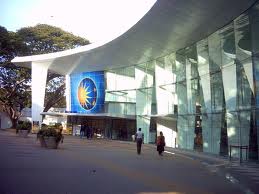
Gaurav Shimpi traces the evolution of film-viewing experience in India, from the dusty cinema halls of yore to swanky multiplexes in every city.
Loud cries and cheers to the hero’s entry, ear-wrenching whistles for the heroine, loud singing and dancing during a song – this is the kind of a movie watching experience that the Bollywood-crazy audience is used to in a movie hall. Though most of the people exhibit the same passion even today, the boundaries of the movie hall have greatly multiplied; all thanks to the multiplex revolution.
 Multiplex theatres have revolutionised the movie watching experience through their imaginative ambience, extraordinary infrastructure, state-of-the-art audio-visual quality, comfortable seating along with other allied facilities like eating stalls with a wide variety of on its menu, bowling arenas, snooker tables and book stores. It is not just the movie watching experience that counts today, it is about the pre- and post-movie watching experience.
Ajay Bijli chairman and managing director of PVR, pioneered the multiplex revolution in India. In 1997, Anupam PVR, India’s first multiplex was opened in Delhi. Since then, the investment in this segment has been on a rise. Many major players like Adlabs, Inox Leisures, Cinemax and Fame entered the multiplex business. But PVR remains the market leader in India.
Gone are the days when, while waiting in the lobby for the show to start, or during the interval, you were excited to get to the samosas, the pastries and cold drinks, and if you were lucky, some oily popcorn at the cinema canteen. The food in most up market multiplexes is as snobbish as the place that serves it, and young India is happy to be part of this snob club. And yet, the experience is no more just about the movie and the food.
These multi-screen theatres, in a bid to lure more customers, are also starting up bowling alleys, karaoke centres, ice-skating rinks, kid zones and gaming zones. This makes for wholesome entertainment to the people; the idea certainly is to have a model where malls would comeupalongside the multiplexes.
Krishna Kumar, a film enthusiast who is an IT professional, puts it, “Multiplex has become a comfortable and perfect weekend hangout for my family, with movies, gaming zones and a mall. My kids love movies, there is a gaming zone for me, and my wife indulges in shopping. Rather than travelling amid the traffic, it is better to get everything under one roof.” To some extent, multiplexes have also become a community hangout place for many people.
Apart from breaking the conventional 12-3-6-9 time schedule, multiplexes have started extra facilities for customers like online ticket booking for movies, home delivery of tickets, SMS booking and toll-free calling services. Some multiplexes like Adlabs have even tied up with other banks to provide loyalty cards for regular visitors. The multiplex culture has certainly kicked off, especially among the young brigade across the metros.
Priyanka Singh, who is in charge of ticket sales at Gold Adlabs, says, “Around 80 per cent of the crowd that I see here every day is in the age bracket of 16 to 30.” Call Centre jobs, availability of ready cash and increasing income of the middle class have lead to this change. Earlier, films were divided into categories like parallel cinema and commercial cinema. Now, there seems to be a new addition to this list films for the multiplex audience. The multiplex audience is perceived to be sleek, trendy, knowledgeable and broad-minded. Therefore, many small budget films or off-beat themes from big banners are purposefully pitched for the multiplex audience.
The multiplex revolution in India is also helping Hollywood business, as some of the best international films, which could not even release in India earlier, are finding a good audience base. “The advent of multiplex has helpedmeacquire the latest Hollywood movies which were impossible earlier,” said Prashant Sinha, a software professional.
Today’s multiplexes save you from old decrepit chairs, long queues, stale popcorns and stinking toilets, all the customary qualities that we had got so used to in single screen theatres. The swanky interiors and commendable infrastructure coupled with revolutionary technology has converted an ordinary 70 mm cinematic experience into a digital, king-size one with incredible sound effects. People are experiencing 4D cinematic experience, where virtual is as close to being real. Today, it should not be a surprise if giant King Kong gives you a slight tickle on your head because that’s the extent to which the technology is advancing.
These multiplexes have flourishedwell in metros in the past decade. Now, there are plans for its expansion in B and C class cities. However, multiplexes have arrived in Kanpur, Amritsar, Lucknow, Indore, Nashik, Aurangabad, and Pimpri-Chinchwad. Many single screen theatres are taken up by big corporations and converted into multiplexes. Still, the multiplexes currently constitute only 4-5 per cent of the total 12,900 screens in India. The Indian film industry which produces the largest number of films per year is further estimated to grow at a compound annual growth rate of 16 per cent – to US$ 4.42 billion by 2011. In the US, there are 117 screens per million people, while in European countries, there are more than 40 screens per million. In India, there are only 12 screens per million people.
This sector also looks very attractive for investments as it requires minimum operating costs and comparatively low investments, and guarantees quick returns and longer life of equipment. Development of the multiplex culture has been mostly in metro areas. The government has now decided to give tax incentives in rural areas under section 80 IB (7A) for the growth of multiplexes.


