
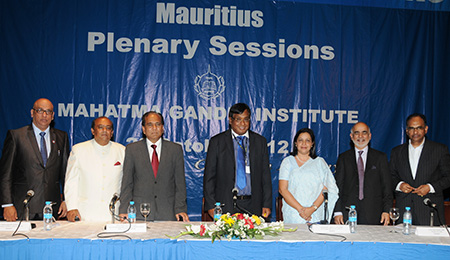
After the success of regional PBDs in New York (2007), Thereafter, Singapore (2008), The Hague (2009), Durban (2010) and Toronto (2011) have hosted regional PBD convention, This year Ministry of overseas Indian Affairs (MoIA) organized 6th Regional Pravasi Bharatiya Divas, Mauritius.
The 6th Regional Pravasi Bharatiya Divas (PBD) Convention was held in Mauritius on october 27-28, 2012. Regional PBDs are organized by the Ministry of overseas Indian Affairs (MoIA), Government of India in collaboration with the host Government, the concerned Indian Mission and organizations catering to the needs of the Indian diaspora. They serve the objective of reaching out to a vast majority of our 25 million-strong diaspora, who for various reasons, are unable to attend the annual main PBD conventions in India and benefit from its deliberations. Regi

onal PBD conventions are also helpful to local populations who are not of Indian origin but are interested in doing business and/or collaborating with India.
Expectations and Aspirations of the Indian Diaspora from India

Professor Dasarath Chetty was an invited speaker by the Ministry of Overseas Indian Affairs at the Opening Plenary of PBD 2012 Mauritius where he discussed on many aspects of Indian Diaspora
What does the Indian Diaspora want, need and expect of India? In order to systematically address the topic four questions need to be answered. Firstly, what essentially characterises and defines the Diaspora? Secondly, what are the categories of needs and expectations? Thirdly, where do these needs, expectations and aspirations derive from? Fourthly, what are the dimensions impacting on Diaspora Expectations? These questions are answered on the understanding that needs and expectations are contextually located and not created in a vacuum.
The twenty seven million people that comprise the Indian Diaspora are characterised by heterogeneity. Differences in Language, religion, geographical area from which they came in India and in which they settled, reasons for leaving India, and the time period in which the migration took place are all factors that contribute to the heterogeneous nature of this social group.
Except in Mauritius, and for a period in Fiji, the Diaspora constitutes an ethnic minority in all countries they settled in. They have all made tremendous progress evidenced by living standards, income and educational levels and all had to deal with being the “other” in their adopted homelands. This sense of “otherness” manifested in Indians having to deal with dominant ethnic groups responses ranging from underlying suspicion to overt hostility given the colonial politics of divide and rule and the vast cultural differences which served as an obstacle to integration.
Despite the Diaspora’s heterogeneity however they generally share a common identity as people of Indian origin, they share values (family and education in particular) and they share a sense of pride in their Indianness. And more recently there seems to be an overt need to connect and reconnect with India as India’s power grows into one of an emerging superpower.
Needs and Expectations
The need to identify with India is ubiquitous. India is viewed as the primary source of identity, culture and values and a sense of pride springs from having roots in an ancient civilisation that provides an emotional and spiritual connection. This need is linked to the need to be accepted as global Indians with India’s response being the establishment of the Ministry of Overseas Indian Affairs, PBD conventions, Overseas Citizen of India and Person of Indian Origin cards and the like.
Then there is the need of the business class for investment opportunities, partnerships and joint ventures being met by the Overseas Indian Facilitation Centre and other initiatives. The Diaspora’s need for recognition is met by the Bharatiya Saman Awards in recognition of contributions to economy, polity and society abroad. The quest for support for disadvantaged PIO’s is met through the Know India Programme, Scholarships, Cultural Festivals, Youth Clubs and Study in India Programme. There is also the expectation of protection and safety from India ranging in its extreme form of military intervention to protect Indian minorities to diplomatic efforts to abolish discriminatory laws and practices.
Dimensions impacting on expectations
So where do these needs and expectations derive from? They derive from a contextual location having historical, social, political and economic dimensions. The historical dimension relates to the period in which they left India. The first wave left India in ancient times, as merchants to the Middle East and Africa, traders to South East Asia and Buddhist monks to the Far East. The second wave went as slaves, indentured or passenger Indians during colonial times and the third wave in post-colonial India left as businesspeople and professionals mainly to Europe and the USA and as skilled, semi-skilled and unskilled workers mainly to the Gulf states. Expectations have also been shaped by the Diaspora’s historical experiences with India and the manner in which India implemented foreign policy.
The Social dimension impacting on needs and expectations relates to the polar opposites of Integration and Marginalisation by dominant groups. Integrated communities are generally accepted and marginalised communities generally face hostility. Being a majority community as in Mauritius as opposed to being a minority community as in all other countries also impacts on needs and expectations. Perceptions of dominant groups as to whether the minority is inclusive and accepting or exclusive and self- segregating also impacts on the responses of out-groups. Exclusiveness as opposed to inclusiveness has been a feature of Indians abroad given their widely held belief that westernisation leads to a degeneration of Indian values and there was an unwillingness to inter-marry with locals given vast cultural chasms, lifestyles and prejudices.
The Economic and Political dimensions also relate to degrees of integration or marginalisation. Affirmative Action policies, Employment Equity and Social Redress initiatives, in Malaysia and South Africa, for example, have contributed to feelings of marginalisation which are compounded by anti-Indian riots between 1944-1949 in Kenya, Uganda and South Africa (Historical dimension). Marginalised, exclusive communities facing discrimination, worsened by undemocratic political systems have stronger needs for acceptance, protection and safety from India. Apartheid South Africa was a case in point. The overthrow of a democratically elected Indian President in Fiji by the military is also a case in point. And in colonial societies characterised by forced assimilation as was the case for the Francophone Diaspora in Reunion, Guadeloupe and Martinique the need for recognition from India, for identification and rediscovery of roots is paramount.
Politically and Economically integrated, inclusive communities in democratic societies (USA and UK for example) have a need for business engagement, for identification with India, for recognition because of philanthropy and achievement and face no backlash for being proud of their multiple identities in the era of globalisation. In South Africa, with only 18 years of citizenship and despite its anti-apartheid role, the Indian community may not have had long enough to prove its loyalty and fear African perceptions of a divided loyalty or outright disloyalty if there is overt identification with India.
In 1939 Jawaharlal Nehru stated “India is weak today and cannot do much for her children abroad but she does not forget them and every insult to them is a humiliation and sorrow for her. And the day will come when her long arm will shelter and protect them and her strength will compel justice for them.” That day has seemingly arrived.


